Acte Préalable how to buy | contact us
Acte Préalable The perfect introduction to polish classical music
New Releases
AP0201
AP0221
AP0222
AP0223
AP0224
AP0225
AP0226
AP0227
AP0228
AP0229
AP0230
AP0231
AP0232
AP0233
AP0234
Coming soon
Catalogue
Artists Index
Out of Print
Scores
Distributors
How to buy
Contact us
Links
Credits


Zygmunt Stojowski (1870-1946)
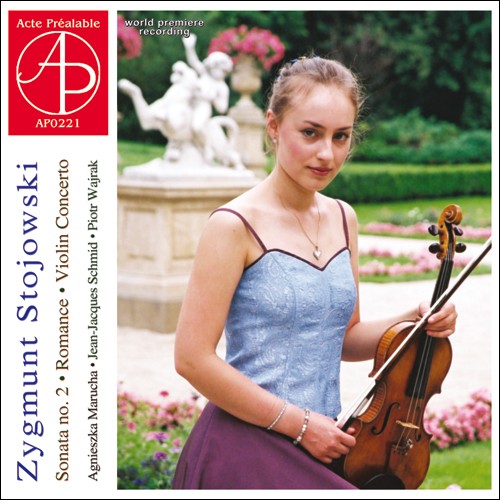
Violin concerto - Romance - II Sonata
New Release
AP0221 , DDD - TT: 64'28"
Copyright (R)2008, (C)2009
World Premiere Recording


  1. Sonata for violin and piano No. 2 in E major Op. 37
  2. Romance for violin and orchestra Op. 20
  3. Concerto for violin and orchestra in G major Op. 22

Marucha Agnieszka, violin
Schmid Jean-Jacques, piano
.Orkiestra PSM II st. im. J. Elsnera,
Wajrak Piotr, conductor

booklet: Agnieszka Marucha (Polish, English, German)


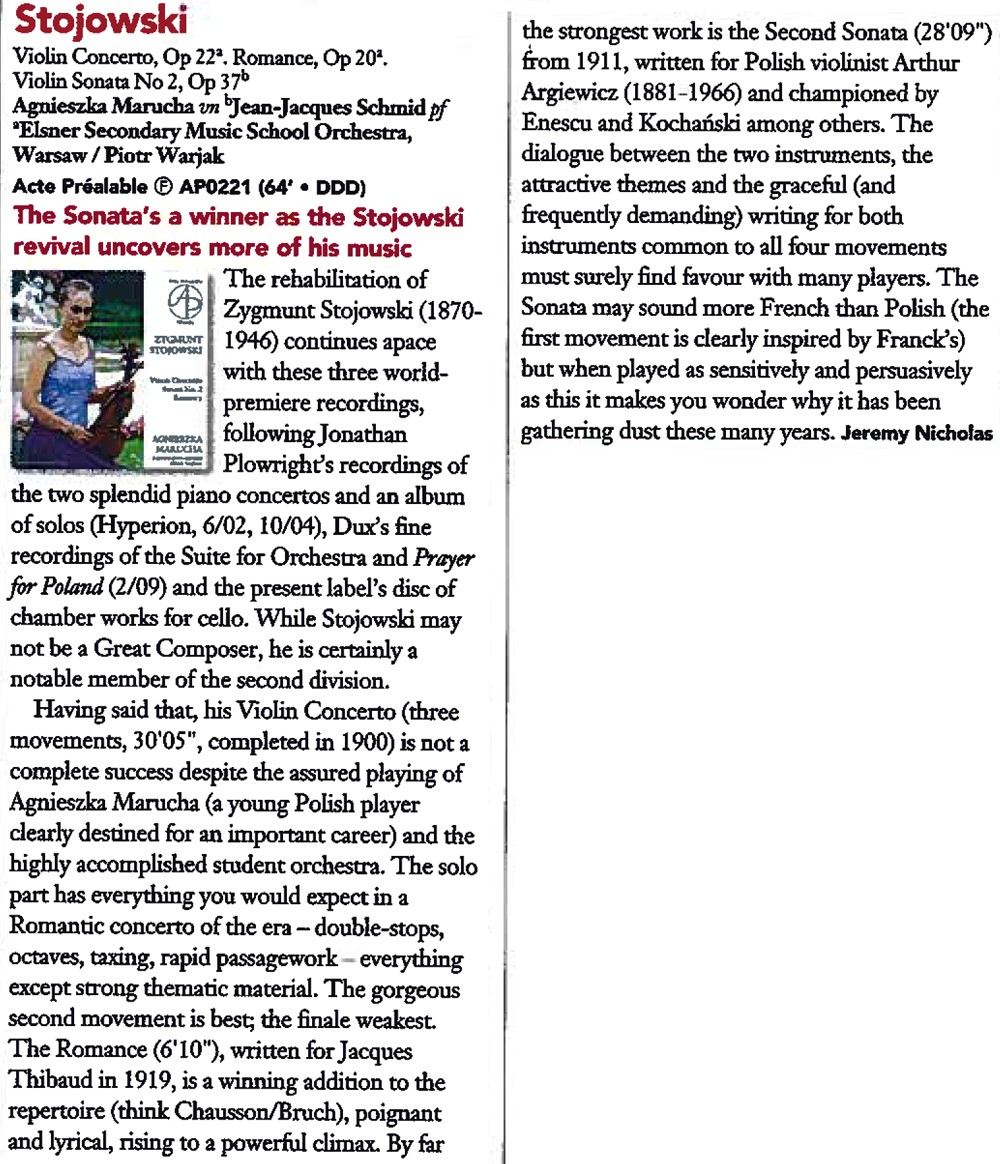
The Sonata's a winner as the Stojowski revival uncovers more of his music - The rehabilitation of Zygmunt Stojowski (1870-1946) continues apace with these three world-premiere recordings, following Jonathan Playwright's recordings of the two splendid piano concertos and an album of solos (Hyperion, 6/02, 10/04), Dux's fine recordings of the Suite for Orchestra and Prayer for Poland (2/09) and the present label's disc of chamber works for cello (AP0144). While Stojowski may not be a Great Composer, he is certainly a notable member of a the second division. Having said that, his Violin Concerto (three movements, 30'05", completed in 1900) is not a complete success despite the assured playing of Agnieszka Marucha (a young polish player clearly destined for an important career) and the highly accomplished student orchestra. The solo part has everything you would expect in a Romantic concerto of the era - double steps, octaves, taxing, rapid passagework - everything excerpt strong thematic material. The gorgeous second movement is the best; the finale weakest. The Romance (6'10") written for Jacques Thibaud in 1919, is a winning addition to the repertoire (think Chausoon/Bruch), poignant and lyrical, rising to a powerful climax. By far strongest work is the Second Sonata from 1911, written for polish violinist Arthur Argiewicz (1881-1966) and championed by Enescu and Kochański among others. The dialogue between the two instruments, the attractive themes and the graceful (and frequently demanding) writing for both instruments common to all four movements must surely find favour with many players. Sonata may sound more French than Polish (the first moment is clear inspired by Franck's), but when played as sensitively and persuasively as this it makes you wonder why it has been gathering dust these many years. (Jeremy Nicholas, The Gramophone, January 2010)